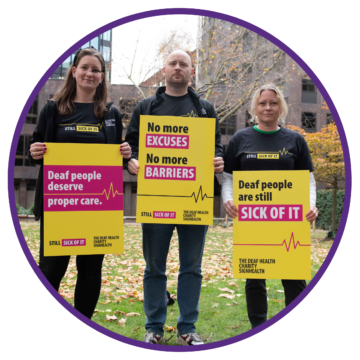
Domestic abuse and sexual violence can affect anyone, but deaf victims often face additional barriers when seeking help. Many professionals in healthcare, policing and social care do not fully understand deaf people’s communication needs or the ways abuse may be experienced, disclosed and investigated. As a result, warning signs can be missed, victims may struggle to access support, and opportunities to intervene are lost.
Healthcare, Police and Social Care responses
Professionals are often the first point of contact for victims of domestic abuse and sexual violence. However, deaf people may face significant challenges when trying to access services designed primarily for hearing individuals.
In healthcare settings, appointments are sometimes conducted without qualified British Sign Language (BSL) interpreters. Family members or partners may be asked to interpret, creating serious safeguarding risks when the partner is the abuser. Healthcare professionals may focus on communication difficulties while overlooking indicators of domestic abuse, sexual assault or coercive control.
Police responses can also be affected by communication barriers. Deaf victims may struggle to report incidents through telephone-based systems, while delays in accessing interpreters can affect investigations. Officers may misunderstand a victim’s behaviour, emotions or communication style, leading to inaccurate assessments of risk or credibility. This can be particularly harmful in cases of sexual violence, where victims may already fear they will not be believed.
In social care, disability-related concerns may dominate assessments, leaving little space to explore abuse. Professionals may not recognise signs of coercion, sexual exploitation or controlling behaviour, especially where the victim relies on others for communication or daily support.
Common misunderstandings
Several misconceptions contribute to poor outcomes for deaf victims.
One common misunderstanding is that all deaf people can communicate effectively through written English. While some do, others use BSL as their first language and may prefer signing to written communication.
Another misconception is that domestic abuse and sexual violence will be disclosed in the same way as by hearing victims. In reality, communication barriers, fear of misunderstanding and previous negative experiences with services can make disclosure more difficult.
Professionals may also overlook forms of abuse that disproportionately affect deaf people, including:
- Preventing access to interpreters.
- Controlling phones, video relay services or communication devices.
- Refusing to relay important information.
- Isolating someone from the deaf community.
- Exploiting dependence on support services.
- Using communication barriers to conceal domestic abuse or sexual violence.
Signs of sexual violence may also be missed when professionals assume communication difficulties are the primary issue. Victims may struggle to explain experiences of sexual assault, coercion or unwanted sexual contact, particularly when appropriate communication support is unavailable.
Trauma-informed and accessible practice
Improving outcomes requires services to be both trauma-informed and accessible.
Professionals should create environments where deaf people can communicate safely, independently and confidentially. This includes providing qualified interpreters, making information available in accessible formats and ensuring victims can speak without family members or partners present.
Trauma-informed practice recognises that victims of domestic abuse and sexual violence may be fearful, distressed or reluctant to disclose their experiences. Professionals should:
- Listen without judgement
- Avoid assumptions about communication preferences
- Allow sufficient time for discussions
- Check understanding throughout conversations
- Provide information in accessible formats
- Consider the impact of trauma on communication
- Refer to specialist deaf advocacy and support services where available.
Training should include deaf awareness, safeguarding, domestic abuse, sexual violence and the specific ways that perpetrators may use communication barriers as a form of control.
Our recommendations
Improving support for deaf victims requires systemic change.
Key policy recommendations include:
- Mandatory training on deaf awareness, domestic abuse and sexual violence for healthcare, police and social care professionals.
- Guaranteed access to qualified interpreters during safeguarding, healthcare and criminal justice processes.
- Accessible reporting mechanisms, including text, online and video-based options for reporting abuse and sexual offences.
- Specialist funding for deaf-led domestic abuse and sexual violence support services.
- Routine screening and risk assessment that considers communication barriers and disability-related abuse.
- Improved data collection on the experiences of deaf victims to inform policy and service design.
- Clear safeguarding guidance on recognising communication-based coercive control, sexual exploitation and disability-related abuse.
Conclusion
Deaf victims of domestic abuse and sexual violence often face barriers that make it harder to seek help, report offences and access support. When professionals lack awareness of communication needs and the specific forms of abuse experienced by deaf people, serious risks can be overlooked. By improving training, accessibility, trauma-informed practice and specialist support, healthcare, police and social care services can ensure deaf victims are seen, believed and protected.
Need support or training?
Deaf victims of domestic abuse and sexual violence can face extra barriers to getting help. Professionals play an important role in making sure support is accessible, safe and effective.
Our service provides specialist, trauma-informed support for deaf survivors of domestic abuse and sexual violence. We offer advice, advocacy and support for survivors, as well as guidance for professionals.
We also deliver training and consultancy for healthcare, police, social care, education and voluntary sector organisations. Our sessions help teams improve deaf awareness, recognise abuse, communicate effectively and create more accessible services.
To discuss a referral, book training, or explore consultancy support, contact our team today. Together, we can help ensure deaf survivors are seen, believed and supported.